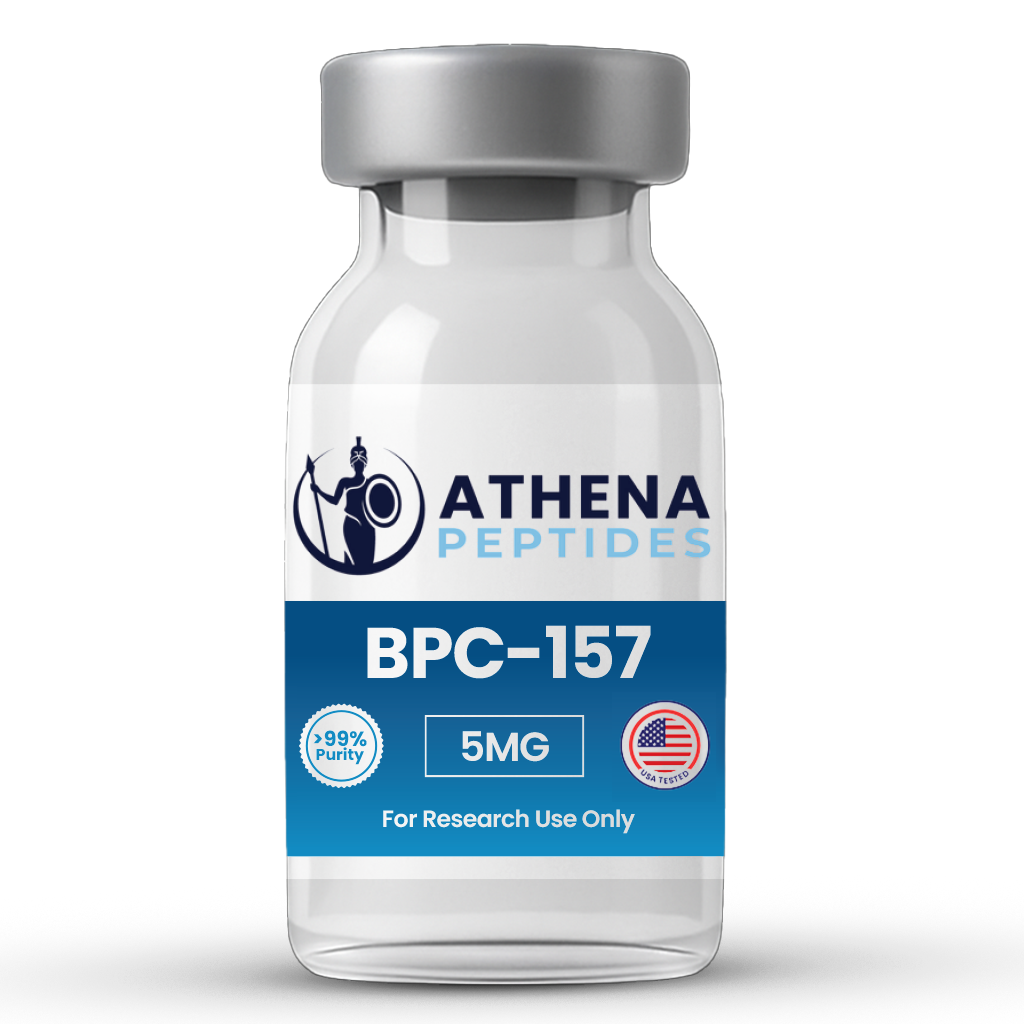
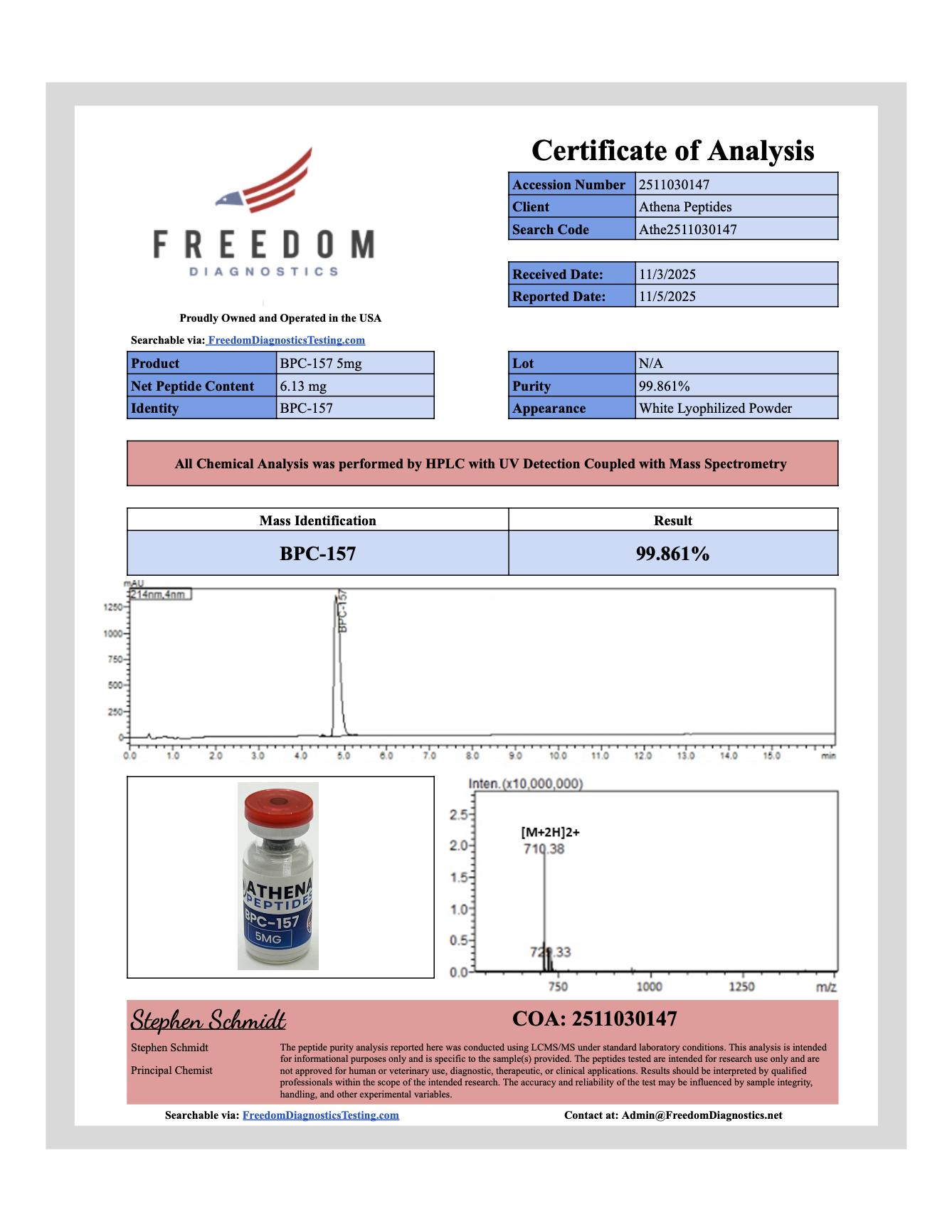
BPC-157 5MG
$25.00MG
Descriptor:
BPC-157, short for “Body Protection Compound-157,” lives up to its name in research settings, suggesting it may accelerate tissue repair and reduce inflammation throughout the body. This 15-amino acid peptide, derived from a protective stomach protein, has shown promising results in preclinical studies for muscle, tendon, and ligament healing. Studies show it promotes growth factors essential for recovery while supporting gut health. Athletes and researchers alike are exploring its potential for faster healing and overall wellness support.
Details:
- Purity: ≥ 98% (HPLC)
- Molecular Formula: C62H98N16O22
- Molecular Weight: 1419.55 g/mol
- Sequence: Gly-Glu-Pro-Pro-Pro-Gly-Lys-Pro-Ala-Asp-Asp-Ala-Gly-Leu-Val
- Form: Lyophilized powder
- Storage: –20°C, dry, protected from lightSolubility: Sterile water or bacteriostatic saline
Intended Use:
For research purposes only.
In stock
Overview
BPC-157, short for “Body Protection Compound-157,” lives up to its name in research settings. Originally discovered in human gastric juice, this peptide demonstrates an impressive ability to protect and heal various tissues throughout the body. What makes BPC-157 particularly fascinating is its stability – unlike many peptides that break down quickly, BPC-157 remains stable in harsh conditions, including stomach acid, making it an ideal subject for diverse research applications.
KEY CHARACTERISTICS
MOLECULAR COMPONENTS
- Formula: C62H98N16022
- Weight: 1419.54 g/mol
- Total Peptide: 5 mg
PHYSICAL PROPERTIES
- Form: White to off-white lyophilized powder
- Solubility: Readily dissolves in water
- Stability: Excellent when stored properly
- Storage: Keep refrigerated 36‑46 °F (2‑8 °C)
HOW IT WORKS
BPC-157 operates through multiple fascinating mechanisms that researchers are still uncovering:
Primary Mechanisms
Angiogenesis Promotion
Stimulates VEGF and new blood vessel formation
Growth Factor Modulation
Increases EGF, IGF-1, and other healing factors
Nitric Oxide System
Nitric Oxide System Enhances NO production for improved blood flow
Systemic Protection
Provides organ-protective effects throughout the body
Protective Mechanisms
Cellular Protection
Shelds cells from various stressors inclduing oxidative damage
Tissue Preservation
Helps maintain tissue integrity under challenging conditions
Systemic Coordination
Appears to coordinate healing responses across multiple organ systems
RESEARCH FINDINGS
The breadth of BPC-157’s effects in research is truly remarkable:
Gastrointestinal Healing
Given its gastric origin, BPC-157 shows exceptional promise in digestive system research. Studies demonstrate:
- Rapid healing of ulcers
- Protection against inflammatory bowel conditions
- Restoration of gut barrier function
- Healing of fistulas – abnormal connections between organs
Inflammation Control
Dual anti-inflammatory pathways for comprehensive effect
Healing Speed
Complementary mechanisms accelerate overall repair timeline
Research Applications
Musculoskeletal Repair
Enhanced recovery in connective tissue research:
– Accelerated tendon and ligament healing
– Improved muscle tear recovery
– Enhanced joint capsule repair
– Reduced adhesion formation
Cardiovascular Studies
Cardiac and vascular research applications:
– Post-MI cardiac remodeling
– Vascular injury repair
– Endothelial function improvement
– Reduced cardiac fibrosis
Gastrointestinal Healing
Digestive system repair studies:
– Ulcer healing acceleration
– IBD model improvements
– Intestinal barrier restoration
– Fistula closure research
Neurological Applications
Nervous system regeneration:
– Peripheral nerve repair
– Spinal cord injury models
– Neuroprotection studies
– Blood-brain barrier research
Research Advantages
Simplified Design
Two-peptide system allows clear synergy assessment
Broad Applications
Suitable for diverse tissue types and injury models
Equal Dosing
1:1 ratio simplifies dosing calculations and comparisons
Proven Synergy
Both peptides have established complementary mechanisms
References
- Sikiric P, et al. “BPC 157 therapy: Responsive disorders and clinical advancement.” Pharmaceuticals. 2024.
- Pipes GC, Yang J. “Thymosin β4 in tissue repair and regeneration: Mechanisms and therapeutic applications.” Int J Mol Sci. 2023.
- Gwyer D, et al. “Synergistic effects of BPC 157 and thymosin β4.” Cell Tissue Res. 2019.
- Kumar S, et al. “Combination peptide therapy for enhanced wound healing: BPC 157 and TB-500.” Biomedicines. 2024.
- Staresinic M, et al. “BPC 157 and standard therapy in musculoskeletal repair.” Biomedicines. 2023.