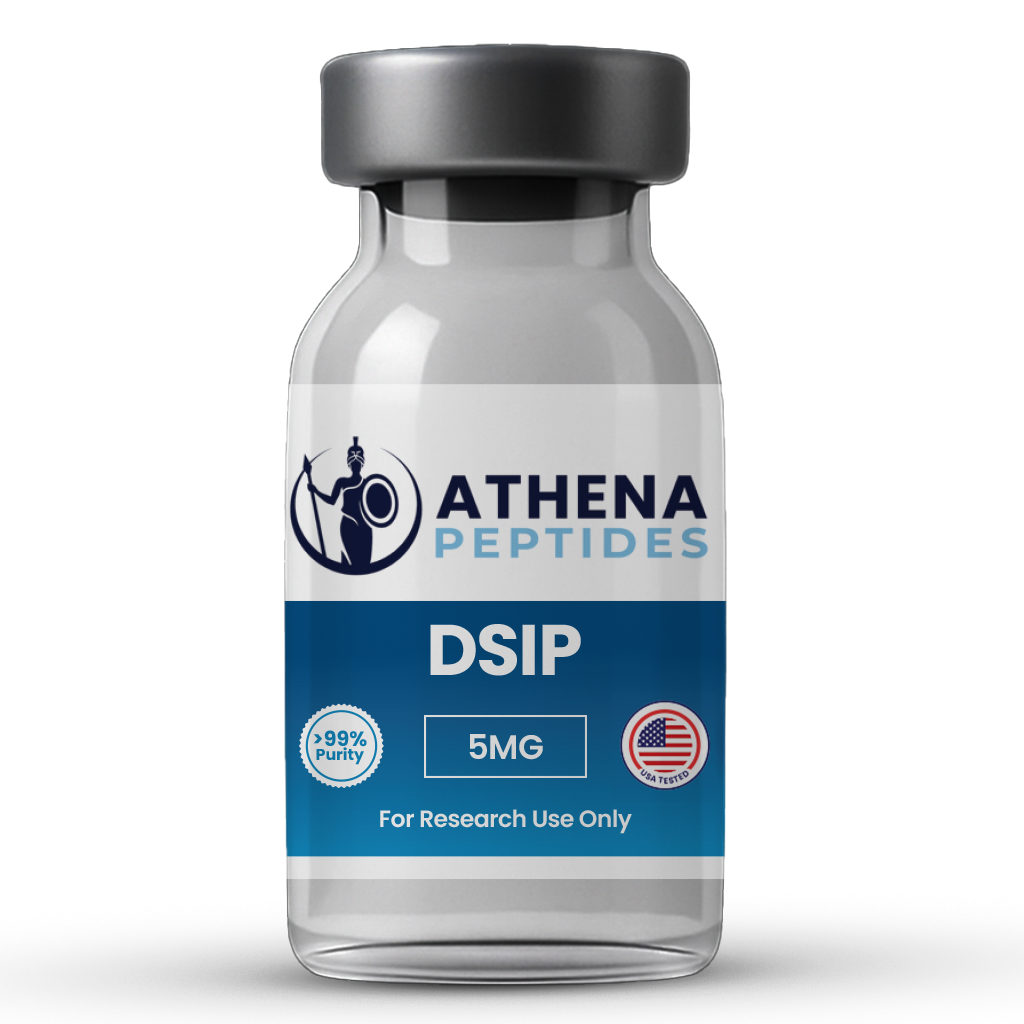
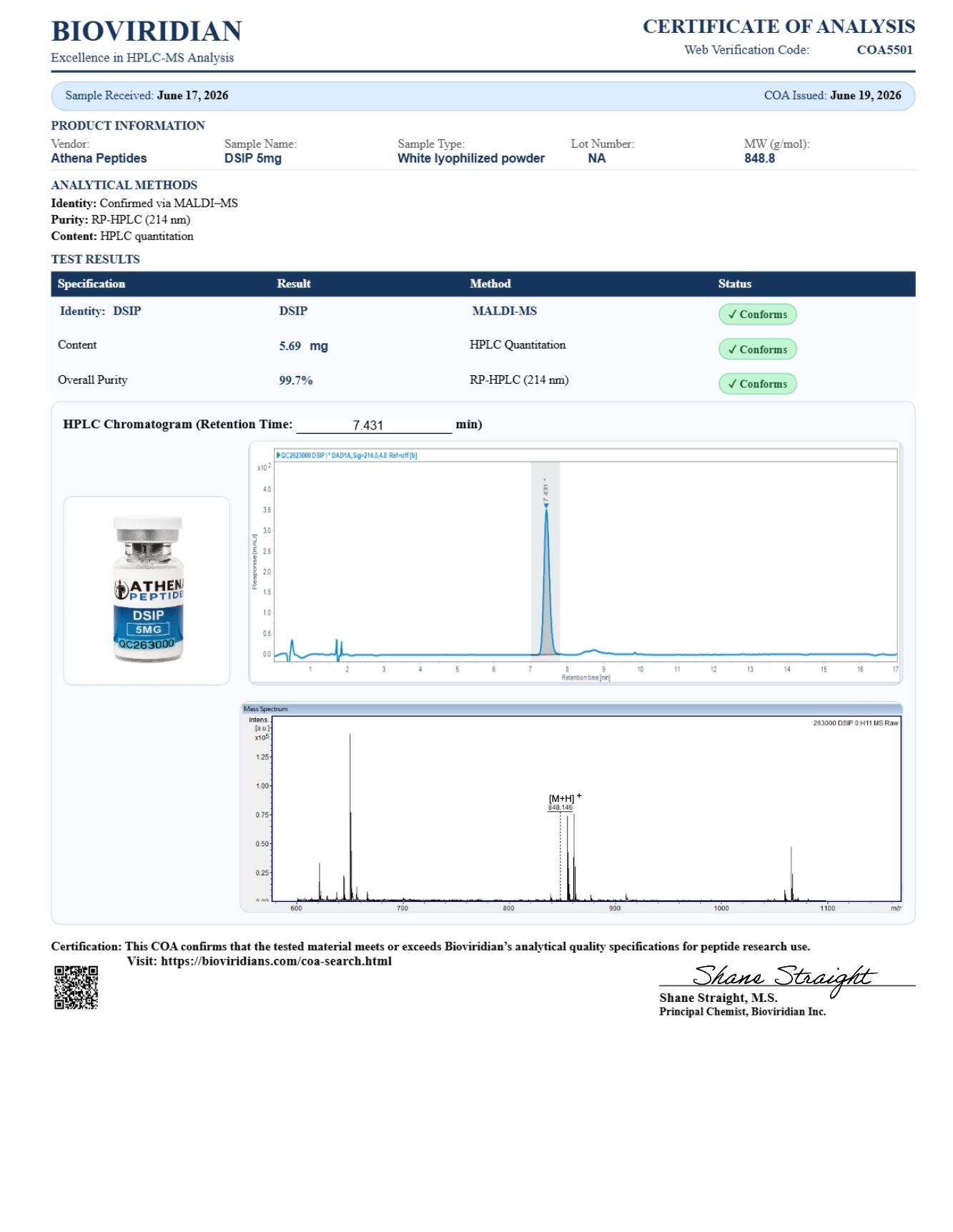
DSIP 5MG
$44.00MG
Research suggests DSIP promotes deeper, more restorative sleep by enhancing slow-wave delta patterns. Studies show this naturally occurring peptide may help lower elevated cortisol levels, supporting balanced stress responses. Scientists have also explored its potential for pain modulation and neuroprotective properties, with animal studies demonstrating improved motor recovery. DSIP works differently than melatonin, targeting sleep quality rather than just timing.
In stock
Overview
Delta Sleep-Inducing Peptide (DSIP) is one of nature’s most intriguing sleep regulators. Despite its name suggesting a simple sleep-inducing function, research has revealed DSIP to be a sophisticated neuromodulator with effects reaching far beyond sleep. This peptide acts more like a conductor of an orchestra, harmonizing various physiological systems including sleep-wake cycles, stress responses, pain perception, and immune function. Its ability to cross the blood-brain barrier makes it particularly valuable for neuroscience research.
Key Characteristics
MOLECULAR PROFILE
- Formula: C35H48N10O15
- Weight: 327.42 g/mol
- CAS: 67727-97-3
- Structure: Lysine-Proline-Valine
PHYSICAL PROPERTIES
- Form: White lyophilized powder
- Solubility: Water-soluble
- BBB Penetration: Crosses blood-brain barrier
- Storage: Keep refrigerated 36‑46 °F (2‑8 °C)
How It Works
DSIP operates through multiple sophisticated mechanisms that orchestrate sleep, stress response, and various physiological systems.
Primary Mechanisms
Neurotransmitter Modulation
Influences glutamate, GABA, and serotonin systems
HPA Axis Regulation
Modulates hypothalamic-pituitary-adrenal responses
Circadian Rhythm Entrainment
Helps synchronize biological clocks
Sleep-Specific Actions
Slow-Wave Sleep Promotion
Enhances deep, restorative sleep phases
Sleep Architecture Normalization
Improves overall sleep structure and balance
Sleep Spindle Enhancement
Increases sleep spindle activity and continuity
Research Findings
Research has uncovered DSIP’s diverse effects across multiple physiological systems, revealing its sophisticated role as a neuromodulator.
Sleep Enhancement
Studies demonstrate significant sleep improvements:
- Increased slow-wave (deep) sleep duration
- Improved sleep efficiency and quality
- Reduced sleep onset latency
- Better sleep continuity with fewer awakenings
- More refreshing sleep without morning grogginess
Stress Response Modulation
Research shows stress-protective effects:
- Reduced cortisol levels under stress
- Better adaptation to chronic stress
- Improved stress resilience
- Protection against stress-induced damage
- Normalized autonomic nervous system responses
Skin and Wound Healing Investigations
Laboratory experiments have explored KPV’s role in skin health and repair processes.
- May support natural healing mechanisms
- Helps maintain skin barrier function in research models
- Early findings show promise for tissue repair studies
Neurological Research Applications
Emerging studies are investigating KPV’s potential effects on neuroinflammation.
- Early-stage research on neuroinflammatory processes
- Potential applications in nervous system models
- May influence inflammatory responses in neural tissue
Cellular Regeneration Studies
Research has indicated that KPV may play a role in supporting cellular repair processes.
- Influences cellular response to damage
- May initiate repair mechanisms
- Supports regeneration processes in laboratory models
Structural & Pharmacological Insights
Receptor Binding Modes
Cryo-electron microscopy structures reveal GLP2-T engages both GIPR and GLP-1R through their orthosteric binding pockets in the N-terminal extracellular domain. The C20 fatty acid modification does not directly contact the receptor but positions the peptide for enhanced G protein coupling efficiency.
Transmembrane Domain Conformations
Active-state receptor structures demonstrate GLP2-T stabilizes outward movement of transmembrane helix 6, creating Gs binding interface geometry. The bias toward cAMP signaling at GLP-1R correlates with reduced conformational changes in intracellular loop 3, limiting β-arrestin recruitment.
Islet Synergy Mechanisms
Co-infusion studies demonstrate GIP + GLP-1 produce supraadditive insulin secretion (>2x individual effects). GLP2-T recapitulates this synergy in single-molecule format. Mechanistically, parallel cAMP generation from both receptors amplifies PKA-dependent phosphorylation of KATP channels and voltage-gated calcium channels, maximizing glucose-stimulated insulin secretion.
GIPR Requirement for Efficacy
Genetic ablation studies in human islets confirm GLP2-T’s insulinotropic actions require functional GIPR. In GIPR knockout models, GLP2-T loses ~60% of glucose-lowering capacity, demonstrating GIP signaling is non-redundant despite GLP-1R activation.
Potential Side Effects in Research
While preclinical studies in laboratory models have generally shown KPV to be well-tolerated, researchers should be aware of the following considerations:
Safety Data
Limited long-term safety data is available, as most studies have focused on short-term applications
Dosing Parameters
Optimal dosing parameters for various research applications are still being established
Variable Responses
Individual cellular responses may vary in different research models
Compound Interactions
Potential interactions with other compounds in experimental settings remain under investigation
References
- Luthringer R, et al. “Delta sleep-inducing peptide (DSIP): a still unresolved riddle.” J Psychiatr Res. 2006.
- Khvatova EM, et al. “Delta sleep inducing peptide (DSIP): An overview.” Neurosci Biobehav Rev. 1995.
- Sudakov KV, et al. “Delta-sleep inducing peptide and neuronal activity after glutamate microiontophoresis.” Neurosci Behav Physiol. 2001.
- Graf MV, et al. “Delta Sleep-Inducing Peptide Recovers Motor Function in SD Rats after Focal Stroke.” Molecules. 2021.
- Chen L, et al. “Neuropeptides in sleep regulation: Emerging therapeutic targets.” Sleep Med Rev. 2024.
- Gangwar A, et al. “Phosphorylated DSIP restores spatial memory and p-CREB expression at high altitude.” Life Sci. 2018.
- Iyer KS, McCann SM. “Delta sleep inducing peptide (DSIP) stimulates growth hormone release.” Neuroendocrinology. 1987.
- Koplik EV, et al. “DSIP and Deltaran as Approaches to Antistress Protection.” Neurosci Behav Physiol. 2022.
- Walleus H, et al. “Delta-sleep-inducing peptide modulates cytokine expression.” J Neuroimmunol. 1995.
- Yukhananov RY, et al. “DSIP: Interaction with opioid system.” Pharmacol Biochem Behav. 1992.