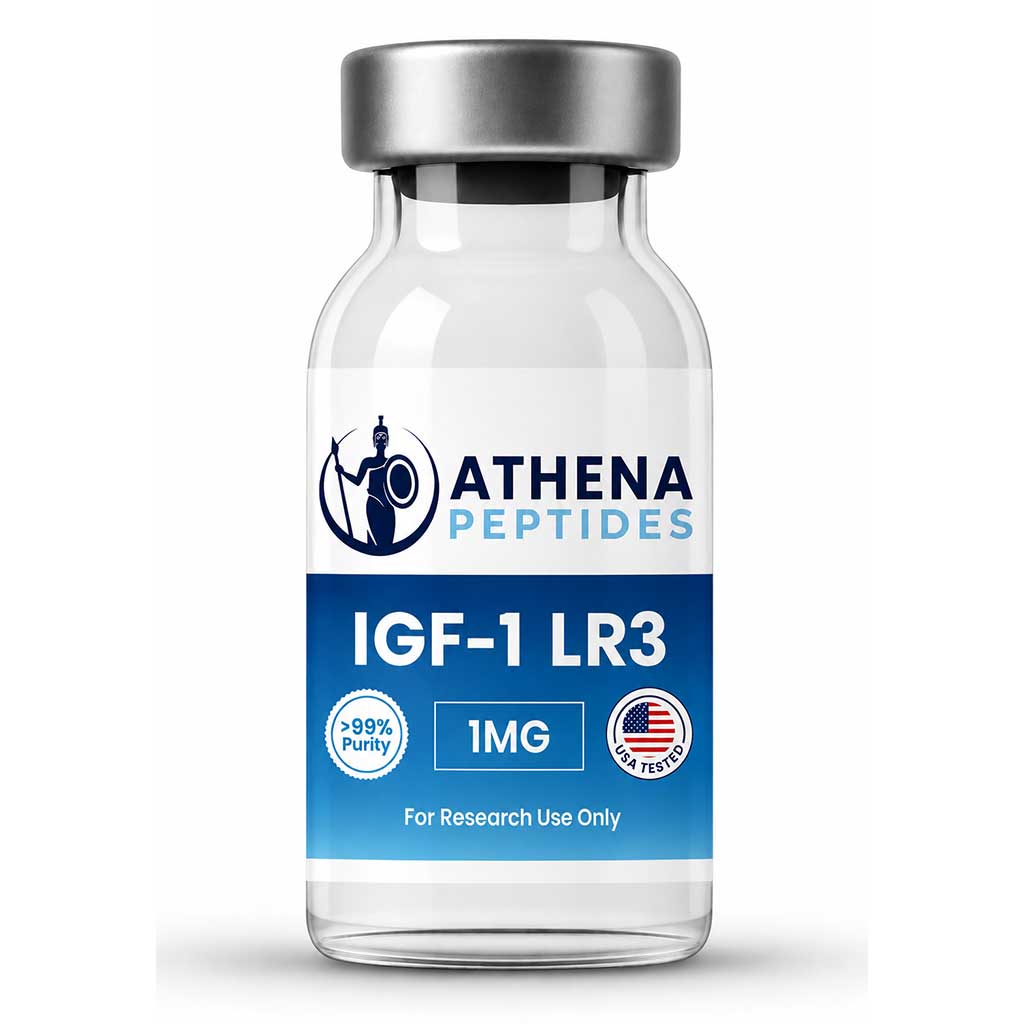
IGF-1 LR3 1MG
$74.00
Research-grade IGF-1 LR3 (Long R³ Insulin-Like Growth Factor-1) is a long-acting analogue of Insulin-Like Growth Factor-1 (IGF-1) widely researched for its role in cellular growth, muscle development, tissue repair, and recovery pathways. Its extended activity makes it a popular compound in studies investigating growth factor signaling and regenerative biology. For Research Use Only. Not for human use.
In stock
Overview
IGF-1 LR3 is one of the most widely researched growth factor analogs for studies involving cellular growth, muscle development, tissue repair, and recovery pathways. Engineered to remain active significantly longer than naturally occurring IGF-1, it allows researchers to investigate prolonged IGF-1 receptor activity without the rapid breakdown associated with native IGF-1.
Originally developed in the 1990s, IGF-1 LR3 has become a trusted reference compound in laboratory research due to its extended duration of action and consistent performance across a wide range of experimental models.
Athena’s research-grade IGF-1 LR3 is supplied as a high-purity lyophilized powder, manufactured under strict quality standards and independently tested to ensure batch-to-batch consistency. Each batch is supported by comprehensive analytical documentation, providing researchers with confidence in the quality and integrity of their studies.
For Research Use Only. Not for human use.

Key Scientific Features
- High-purity IGF-1 LR3 (≥98% by HPLC/MS, receptor-grade)
- Verified 83-amino-acid sequence with Arg³ + 13-aa extension (MFPAMPLSSLFVNG)
- Lyophilized formulation for maximum long-term stability
- Full Certificate of Analysis (COA) with HPLC, MS, amino acid analysis, and bioactivity assay
- Manufactured in GMP-aligned, ISO-compliant facilities
- Suitable for IGF-1R signaling, satellite cell proliferation, and related preclinical studies
- Extended half-life compared to native IGF-1, supporting sustained IGF-1R activation in preclinical models ()
- Increased potency at IGF-1R and downstream Akt/mTOR signaling pathways observed in laboratory settings ()
- Investigated in preclinical models for cellular proliferation and differentiation pathways
- Examined for glucose uptake and metabolic signaling in in-vitro laboratory models
- Studied for neuroprotective signaling in preclinical brain injury models
- Referenced in sarcopenia, muscular dystrophy, wound healing, and tissue regeneration research contexts
Research-Referenced Attributes (Based on scientific literature; for laboratory research use only. Not intended as therapeutic claims.)
Why Researchers Choose Athena Peptides IGF-1 LR3
- Receptor-grade sequence consistent with published preclinical research literature
- Transparent analytical data (HPLC ≥98%, MS confirmation of full sequence)
- Trusted by muscle physiology, regenerative medicine, and endocrinology laboratories
- Competitive research pricing with bulk options
This product is for in-vitro and preclinical laboratory research use only. It has not been evaluated or approved by the FDA and is not intended to diagnose, treat, cure, or prevent any disease or condition. Not for human or animal use.
Peptide Research
- Elmlinger MW et al. (2021) IGF-1 monitoring in sports [PMC: PMC7913862, https://pmc.ncbi.nlm.nih.gov/articles/PMC7913862/].
- Ceda GP et al. (2019) CV effects of IGF-1 [PMID: 31692426, https://pubmed.ncbi.nlm.nih.gov/31692426/].
- White RR et al. (2023) Fetal sheep infusion study [PMC: PMC10205682, https://pmc.ncbi.nlm.nih.gov/articles/PMC10205682/].
- Hubmed (2025) Aesthetic benefits/risks [https://www.hubmeded.com/blog/igf-1-lr3-in-aesthetic-anti-aging-medicine-benefits-and-risks].
- Frontiers (2023) CV effects review [DOI: 10.3389/fendo.2023.1142644, https://www.frontiersin.org/journals/endocrinology/articles/10.3389/fendo.2023.1142644/full].
- PMC (2023) Fetal sheep GSIS study [PMC: PMC10205682, https://pmc.ncbi.nlm.nih.gov/articles/PMC10205682/].